
Shockwave Therapy
Targeted acoustic energy to stimulate healing in tendon and soft-tissue injuries by promoting circulation and cellular repair.
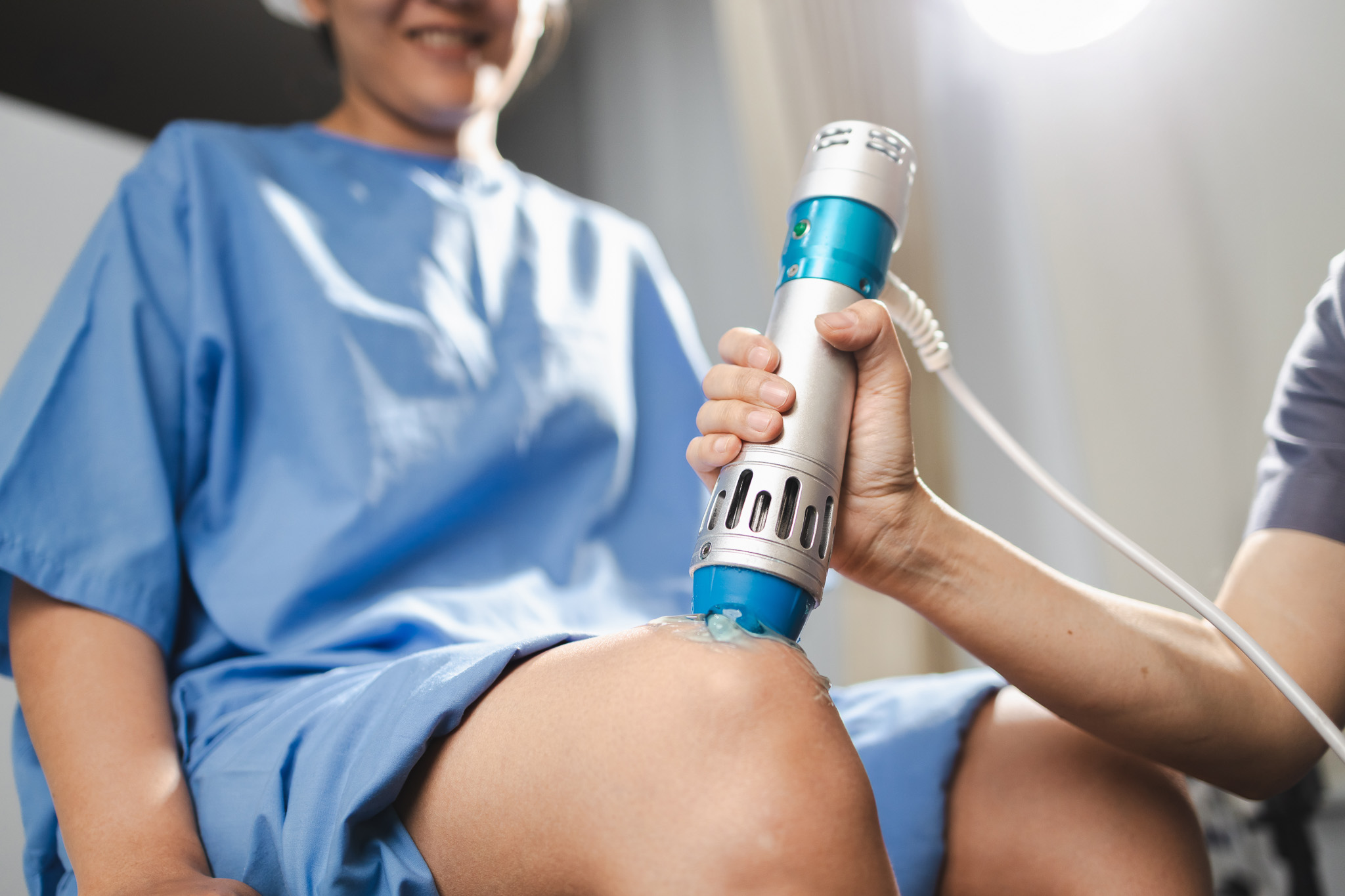
What shockwave therapy is
Shockwave therapy is a non-invasive treatment that delivers high-pressure acoustic waves into tissue. In musculoskeletal medicine it is most commonly used for chronic tendinopathy, selected enthesis-related pain states, and some calcific soft-tissue conditions. There are two main forms used clinically.
Focused shockwave (fESWT)
Generates a wave that converges to a defined depth within tissue, allowing energy to be delivered deeper and more precisely to a chosen focal point.
Radial shockwave (rESWT)
Generates pressure waves with the greatest energy at the applicator tip, dispersing more superficially. Often used for more superficial tendons and broader painful areas.
In plain English
Focused shockwave is generally better when targeting a specific structure at depth; radial is often used when the target is more superficial or a broader stimulus is useful. They are not interchangeable simply because both are called ‘shockwave’.
How shockwave therapy works
Shockwave is thought to work through a combination of mechanotransduction, pain modulation, and tissue remodelling.
Mechanotransduction — converting a mechanical signal into a biological response, altering how local cells behave and stimulating a more active repair environment.
Cellular signalling and matrix remodelling — influencing collagen remodelling, extracellular matrix turnover, growth factor expression and tissue regeneration responses.
Pain modulation — an analgesic effect that can reduce pain enough to allow more meaningful rehabilitation progression.
Vascular and biological effects — changes in local vascular signalling and tissue metabolism, varying by tissue and indication.
In plain English
Some chronic tendon problems become biologically ‘stuck’. Shockwave may help by delivering a mechanical stimulus that changes the local behaviour of the tissue — but the tissue still needs the correct loading programme afterwards. It is not a stand-alone cure.
Focused vs radial: why the distinction matters
The distinction is clinically relevant.
Focused may be more useful when
The pathology is deeper
The target is well-defined
Precise depth targeting matters
The goal is more concentrated energy delivery
Radial may be more useful when
The pathology is superficial
The painful area is more diffuse
A broader pressure-wave effect is appropriate
In practice the best choice depends on tissue depth, diagnosis, chronicity, irritability, patient tolerance and the wider rehabilitation strategy. Modality selection should be dictated by the tissue problem — not by convenience.
Who shockwave therapy may suit
Shockwave may be appropriate in selected patients with Achilles tendinopathy, plantar fasciopathy, patellar tendinopathy, gluteal tendinopathy, tennis elbow, calcific rotator cuff tendinopathy, and selected chronic insertional overload problems.
The evidence base is strongest in chronic tendinopathy and selected shoulder conditions. It is often most useful when symptoms have become persistent, rehabilitation alone has plateaued, the diagnosis is clear, the tissue is still mechanically loadable, and the goal is to improve tolerance to progressive rehab rather than simply suppress pain.
What shockwave can and cannot do
What shockwave may do
Reduce pain in selected chronic tendon and soft-tissue problems
Stimulate a more active healing response in some tendinopathies
Improve tolerance to rehabilitation
Support tissue remodelling in selected overload states
Form part of a broader non-surgical pathway
What shockwave cannot do
Act as a miracle cure
Replace rehabilitation
Work for every painful tendon
Instantly heal structural pathology
Be used without a clear diagnosis and staged plan
The strongest way to describe shockwave: it may improve the tissue’s ability to respond to the right rehabilitation programme. That is very different from saying it ‘heals everything’.
What treatment usually involves
Shockwave is usually delivered as a course rather than a one-off session: a series of sessions over several weeks, targeted to the diagnosed tissue, with progressive loading alongside and follow-up review. The exact number of sessions and settings depend on the tissue, the chronicity, whether the problem is mid-substance or insertional, how irritable the tissue is, and your wider rehabilitation programme.
Healing timeline
During / shortly after: Temporary soreness is common.
First 1–2 weeks: Symptoms may fluctuate.
Weeks 2–6: Gradual change in pain and load tolerance may emerge.
6–12 weeks: Often where more meaningful progress becomes clear, especially with appropriate rehabilitation.
Safety and aftercare basics
Common short-term effects
Soreness during treatment
Local aching afterwards
Temporary increase in symptoms
Skin sensitivity or redness
Less common issues
Bruising
Prolonged flare
Limited benefit
Basic aftercare principles
Avoid over-testing the tissue immediately afterwards, continue the agreed loading plan, understand that some short-term soreness is expected, and judge progress over weeks, not days.
Frequently asked questions
Is radial shockwave the same as focused?
No. They differ in physics, depth profile and energy delivery. Focused converges to a depth within tissue; radial has its greatest energy at the applicator and is generally more superficial.
Which is better — focused or radial?
Neither is universally better. It depends on the tissue, the depth of the target, the diagnosis, and the clinical goal.
Does shockwave hurt?
It can be uncomfortable, especially in sensitive tendon areas, but it is usually well tolerated and treatment is adjusted to the tissue and patient.
How many sessions will I need?
This depends on the condition and tissue involved, but it is commonly delivered as a course over several weeks.
Is shockwave the same as ultrasound?
No. Shockwave is a treatment; diagnostic ultrasound is an imaging tool.
Is shockwave better than PRP?
They do different things. In some tendon conditions shockwave may be the right first step; in others PRP may be more appropriate. Sometimes they sit within the same pathway.
Does shockwave have good evidence?
There is a meaningful evidence base for selected tendinopathies and some shoulder conditions, though quality varies by indication and protocol. It is one of the more evidence-supported non-invasive adjuncts in chronic tendon care, especially when paired with appropriate loading.
Can I train afterwards?
Usually yes, but with sensible modification and a structured loading plan.